 |
florida's pioneer of innovative arts and culture |

|

 Like |
 Sign Up |
|
||||
|
||||
TIGERTAIL CONGRATULATES RICHARD BLANCO! |
It was a great pleasure to work with Richard and we at Tigertail heartily congratulate him on this historic appointment. For over 33 years Tigertail has been there, first on the block presenting vital voices from within our community and beyond. For all these years Mary Luft has served as one of Miami's cultural curators, bringing a pioneering ethos to the arts in Miami. She has shaped not only Miami's cultural landscape, but has quietly nurtured the careers of many young artists, offering guidance and inspiration as they reach to fulfill their dreams. Both of these volumes of Tigertail, A South Florida Poetry Annual will be available while they last at Books & Books in Coral Gables. You may also order them by calling Tigertail at 305 324 4337. Tigertail, A South Florida Poetry Annual, Volume IV 2006 RICHARD BLANCO Editor Introduction As a child of Cuban exiles who could claim citizenship in three countries only forty-five days after my birth, questions about home and place have naturally figured significantly throughout my life and my poetry. But I've realized that these questions are actually very ancient and universal ones. The need to dwell—to exist in a given place or state—is a fundamental human desire, driving each of us to seek a unique physical as well as spiritual place in the world. Think about it: How much of life is spent engaged with questions of place and home, individually and collectively within our communities? As allegory, the Judeo-Christian story of creation affords a powerful example of the fundamental connection between place and being. God first created a place—the Garden of Eden—which provided everything Adam and Eve needed in a state of perfect grace. Their eventual expulsion from their garden paradise suggests the nature of our perpetual desire to return to (or find) a place able to fully sustain and complete us once again; it also symbolically explains the void we feel and the hope we sustain in our wanderlust pursuits for such a proverbial Eden. Other examples of our quest for and connection to place surface in the form of myths throughout the psyche of human history, arts, and culture: from the ancient epics of Homer, to Atlantis, Avalon, and Aztlán, to the modern Shangri-La, The Wizard of Oz, and Peter Pan's Neverland. But what exactly is place? What does it mean to say, I'm a New Yorker, or, I'm a Southerner? How do we come to call someplace, a home? What makes Miami, Miami; or New Orleans, New Orleans; or Santa Fe, Santa Fe? Is it the architecture; the people; the climate; its history; our memories; or our imagination? These are some of the critical questions the poets in this volume ask as they explore the Poetics of Place, seeking to understand those measurable, as well as immeasurable, qualities of places, and our place in these places. More than mere travelogues or memoirs, these works examine the complex ways in which memory, landscape, and imagination collide and intersect to form a sense of place. They represent place as a physical realm of tactile images and details, while also acknowledging that it is in some respects a human construct, a myth, an unreachable ideal that is ultimately indeterminable, and thus, the subject of art. These poems recognize that we are three-dimensional beings who constantly live in the context of place; everything we experience and feel is located in some particular environment lodged in our psyche. These poets understand that where we live defines who we are in some a very significant way; and, conversely, that who we are determines how we perceive our surroundings and where we choose to live. They address what is perhaps one of the most engaging and fundamental questions of human existence: If you could live anywhere in the world, where would you live and why? As I finish this introduction I am sitting by a window overlooking the rocky coast of Maine in winter. In my mind I trace the coastline all the way south to my home in Miami Beach, and think of the birth of the Tigertail Poetry Annual, which originated as an anthology of South Florida writers. I am grateful to Mary Luft, David Beaty, and Tigertail Productions who wholeheartedly supported my vision to expand the themes of place in this year's volume by including 43 poets from all over the country and other parts of the world. As I watch the waves crash futilely over the rocks jutting into this sea, I remember all the wonderful places I've been able to visit through these poets' words, as well as all the places I have lived or traveled through in pursuit of my own Eden. And as snow falls over the beach, so far away from the warm shores of my Miami Beach, I recall what is most important in our contemplation of place: not what we can learn about it, but what each place teaches us about ourselves, who we are, and what it means to be alive—wherever we may be. |
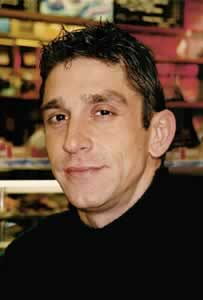 As you surely know by now, Miami's own Richard Blanco read his wonderful inaugural poem, One Today, at the swearing-in ceremony of President Barack Obama!
 You may recall that in 2003, Richard Blanco penned two of the poems in our very first edition of Tigertail, A South Florida Poetry Annual, which was edited by MacArthur Fellowship award winner Campbell McGrath.
 And you may also recall that three years later Tigertail invited Richard Blanco to be the editor of the 2006 Tigertail, A South Florida Poetry Annual, Vol IV. Read Richard's beautiful introduction to that volume below.